Thrips parvispinus (Tp). The industry knows more than it did and, more importantly, has a working answer for what to do about it. Identification is one of the places the fog has genuinely lifted.
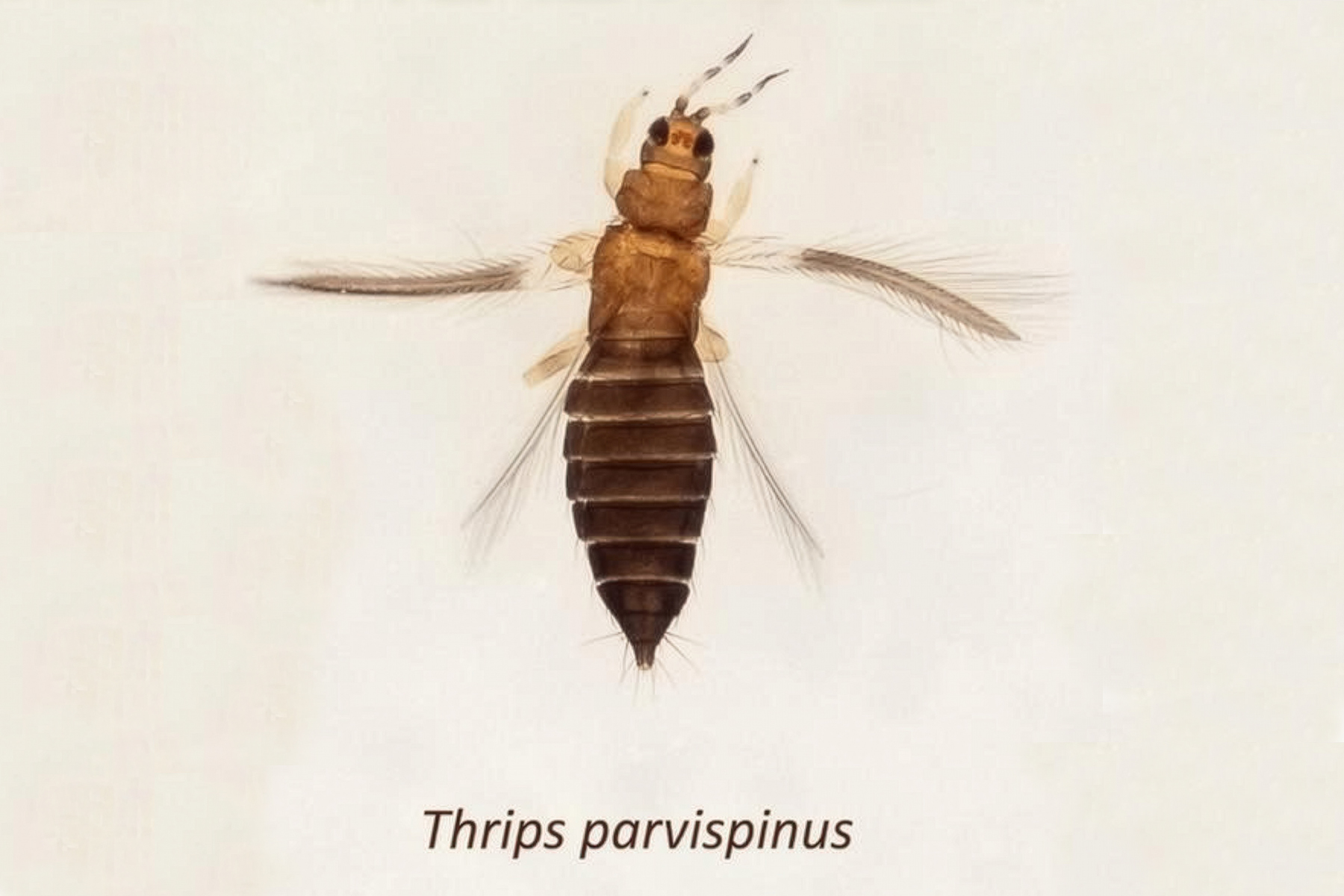
The adult Thrips parvispinus with the dark body, delicate four wings and the dark eyes. If a lone female has no available males, her unfertilized eggs will still hatch into viable males. As a result, every female carries the potential to establish a breeding population by herself.
The leadership decision
Speed has a direct impact on results. Tp reproduces quickly enough that a short delay is often the difference between a killable population and one that becomes a permanently installed budget item.
Last year, a small grower discovered a suspected infestation and acted within days, rather than waiting to confirm it first. He salvaged a shipment that a slower response would likely have lost entirely. Tp breeds quickly, so the grower's fast action saved a lot of money.
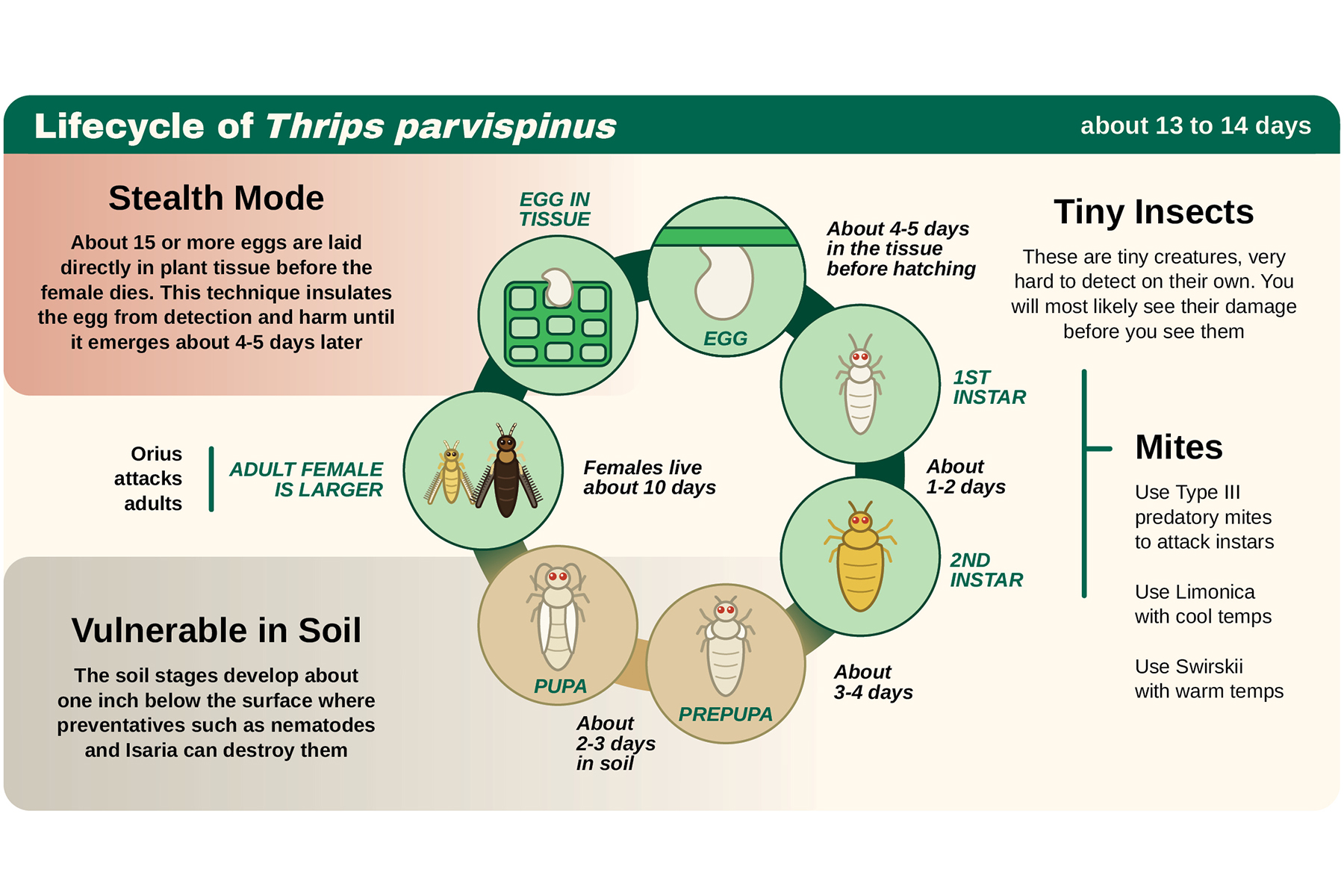
The key problem in our industry is the ability to insert eggs into plant tissue. Not only do they become invisible to inspection, but the egg is protected because, by design, chemistries are not supposed to hurt the plants.
 A field playbook
-
Tp hides among the leaf tips, not so often in the flowers.
-
It moves faster and has a tail-flip defense that WFT does not have.
-
The pesticides for WFT don't work as well.
-
The ones that do tend to increase resistance among two-spotted spider mites.
A program built for WFT and simply pointed at Tp underperforms. A treatment designed for Tp, however, does work.
Prevention is the first step, as The Karate Kid's (1984) Mr. Miyagi well knew: best way to avoid a punch is not to be there, and the cheapest outbreak to fight is the one that never starts.
Heidi Doering, national ornamental specialist at Koppert, put the same idea into field terms: "I tell growers to assume everything coming in is dirty. Don't assume it's clean, and look for Tp." That shift, treating incoming material as infested by default rather than trusting someone else, is rising as standard guidance, not an extra precaution. Use dips and sprenches to cut the load on incoming material.
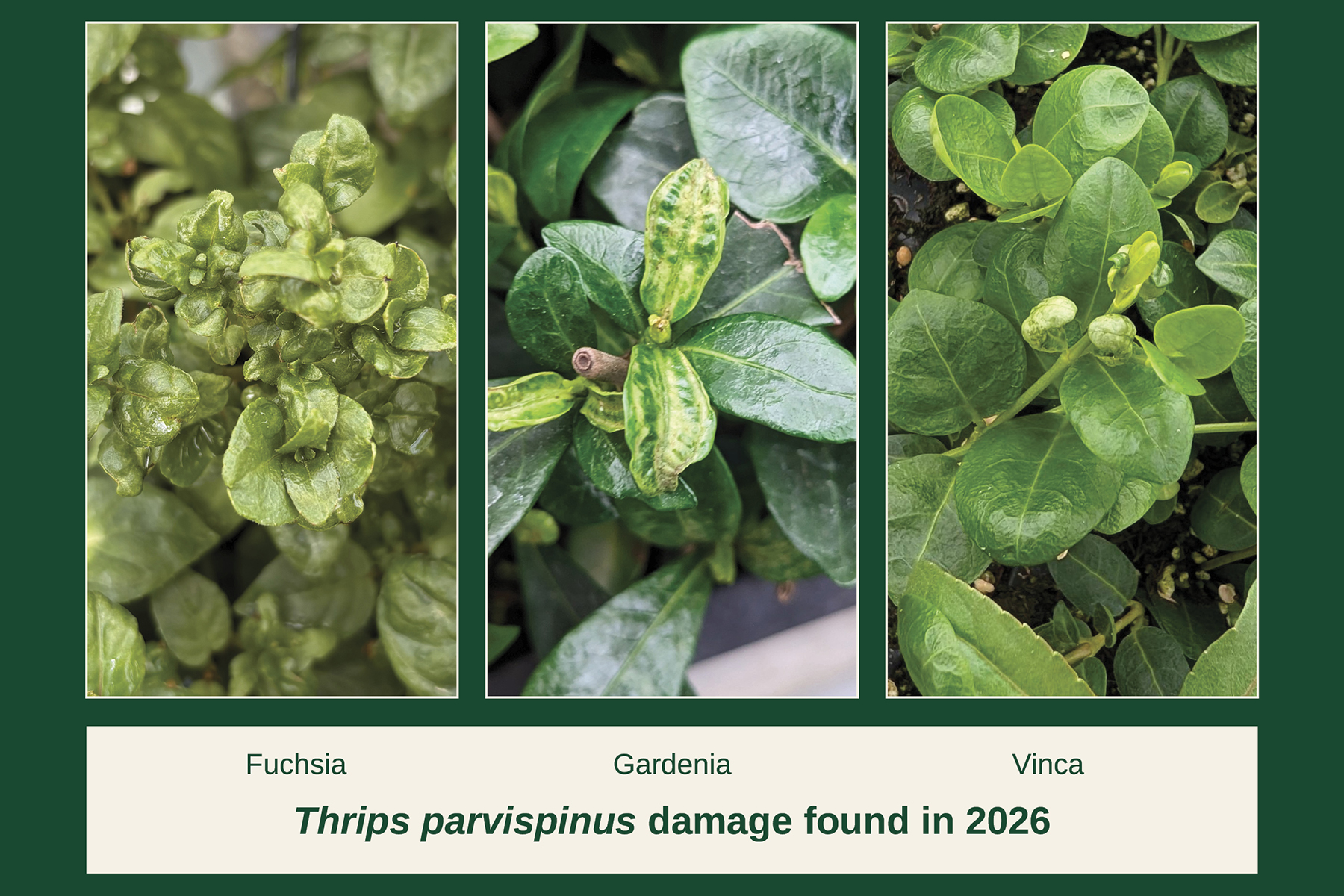
The growing tips of stems often show the first signs of damage. Not that Thrips parvispinus won't appear on flowers — they will — but leaf tips will curl and gnarl, making it difficult for pesticides to get into the nooks and crannies.
Prevention is more than the leaves
Crop host matters, too. A University of Florida trial found insecticides that performed well on one ornamental crop produced no measurable control on another. The lesson: test a protocol before moving it to another crop.
When it comes time for treatment, the industry is migrating toward a blended approach. Biological products, nematodes and fungi, applied both above and below the soil line, lay down a preventative screen that suppresses Tp.
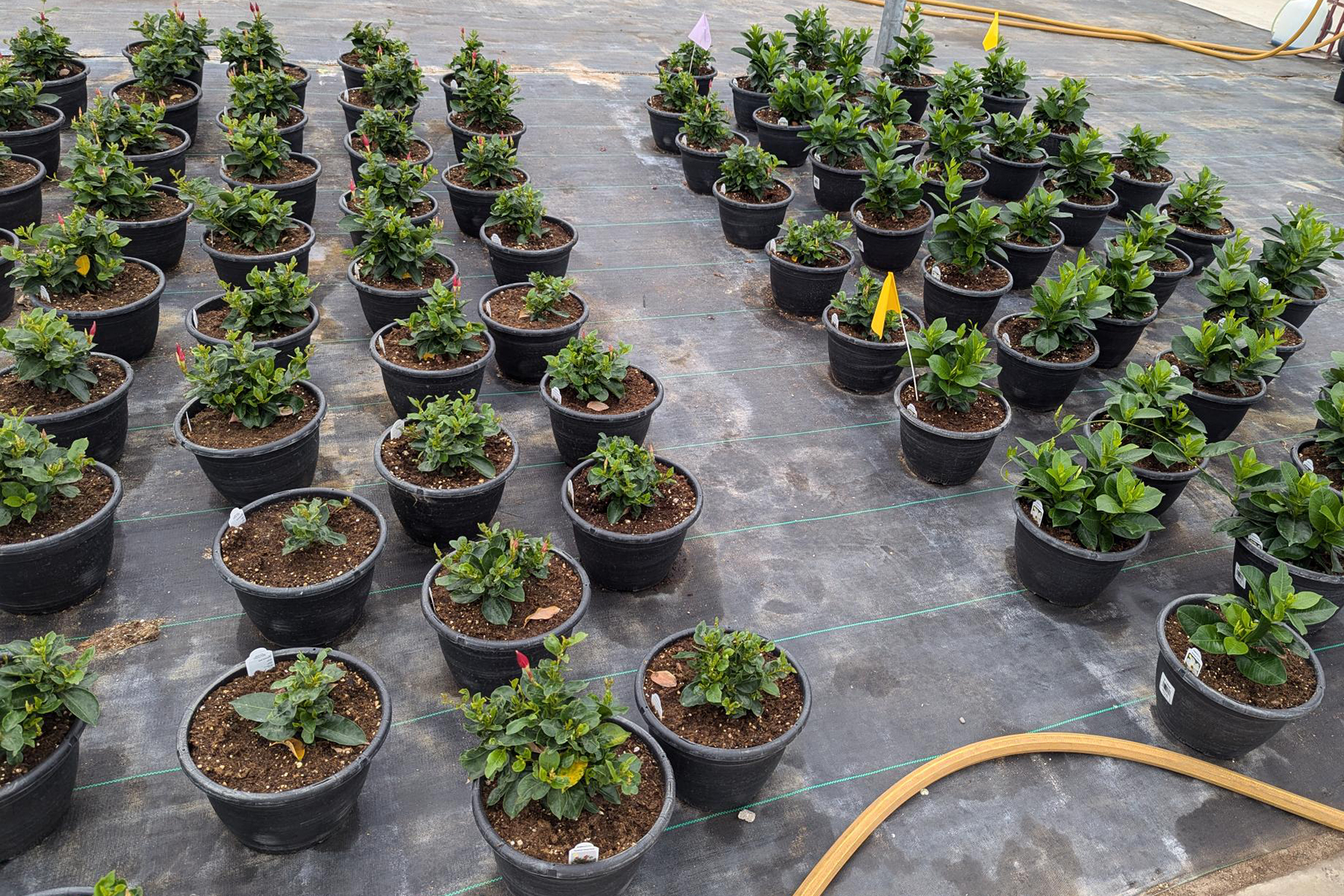
Tp causes more damage than the leaf tips. Left unattended, the pest prevents the product from bulking up on schedule, if at all. In this photo you can see stunted product (middle) that isn't keeping up with the rest of the crop (right).
 |
What success looks like
In the fast, clean version a tropical crop operation caught an infestation early, treated it fast, and lost nothing. No inventory was damaged; plants shipped on schedule at full retail value. Tp reappeared a year later, on a different crop at the same facility, with the same treatment and the same outcome. This shows a functional protocol can produce repeatable results.
The slower, messier version is more likely. A hoya grower started with heavy chemistry when Tp first appeared. When that didn't work, they brought in Koppert's Phil Gerry, who built a blended program that worked. Applied consistently, it held, and the approach still stands today. "We haven't really taken our foot off the gas," he says of the ongoing effort.
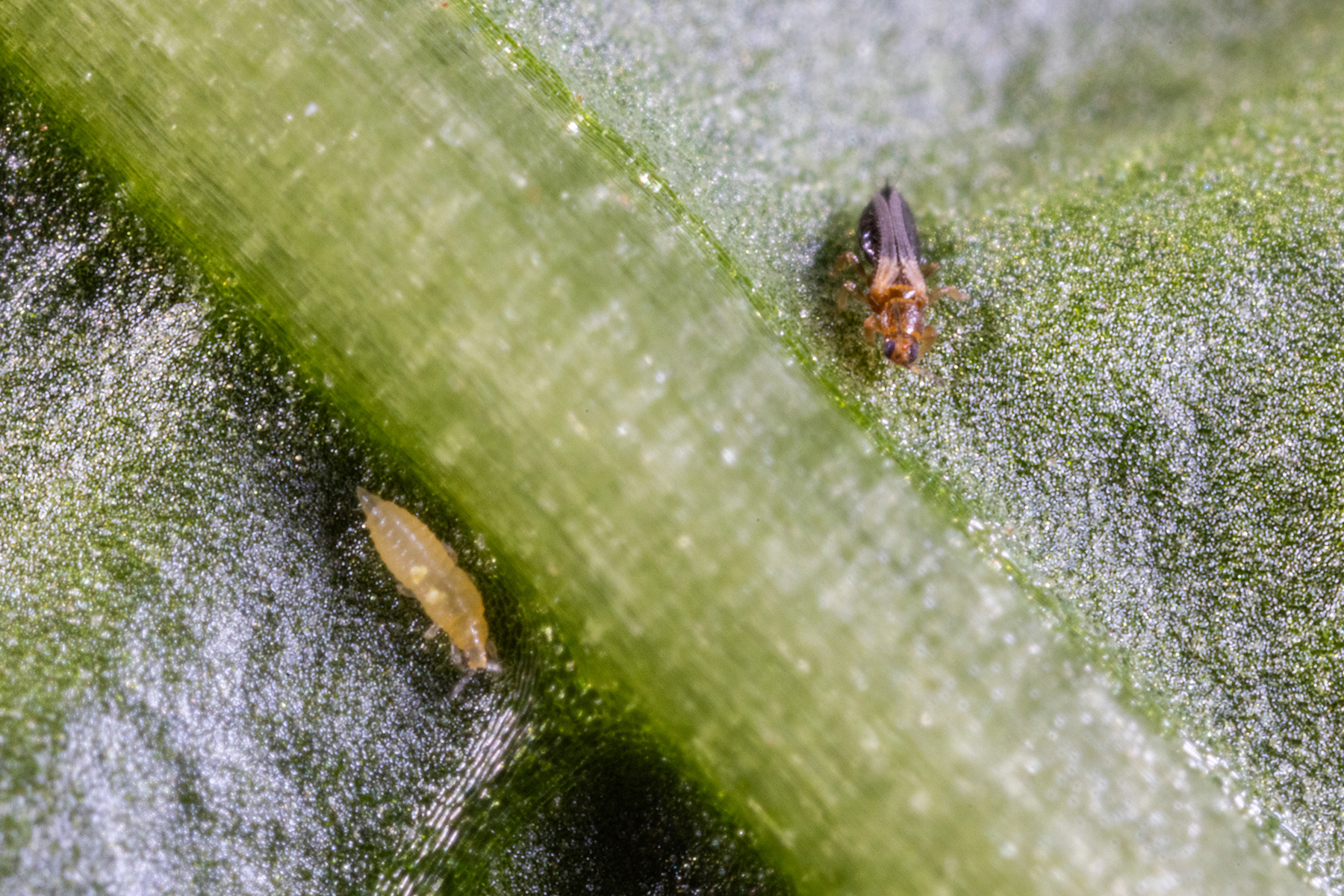
On the right is an adult Thrips parvispinus with the signature two-tone paint job. Look carefully and you can see the dark eye spots on the head. On the left is a 2nd instar, larger and more yellow than 1st instars.
Looking ahead
Across the industry the host list is broader. In 2026 Koppert has confirmed cases on fuchsia, bidens and vinca, plants with no tropical relative anywhere nearby. It's not common, but it did happen. In the future, don't assume a crop is safe just because it isn't a tropical.
One issue is still being debated: trap color. Some growers see stronger results in the field with white cards; recent research favors blue cards but doesn't test against white. No study has tested the full range head-to-head under controlled conditions, so neither claim has been disproven.
Questions like that are why some of today's guidance will likely be refined again before next season. What's already settled is speed. Acting promptly keeps the cost of this pest small; waiting for certainty tends to raise the expense.


